Decision Pulse AI:
Generative BI
and Enterprise Decision Intelligence
Decision Pulse AI is a Generative BI and decision-intelligence platform from Office Solution AI Labs. It is designed to help organizations explore business data, identify patterns, evaluate possible outcomes, and develop actionable recommendations. Available workflows depend on connected data, configuration, product entitlements, and approved integrations.
- Understand and Detect: Explore data and identify changes that merit investigation.
- Evaluate Options: Compare scenarios with explicit assumptions and constraints.
- Review and Learn: Keep people accountable for approvals and measure outcomes.

Illustrative
Example Confidence Score
Example
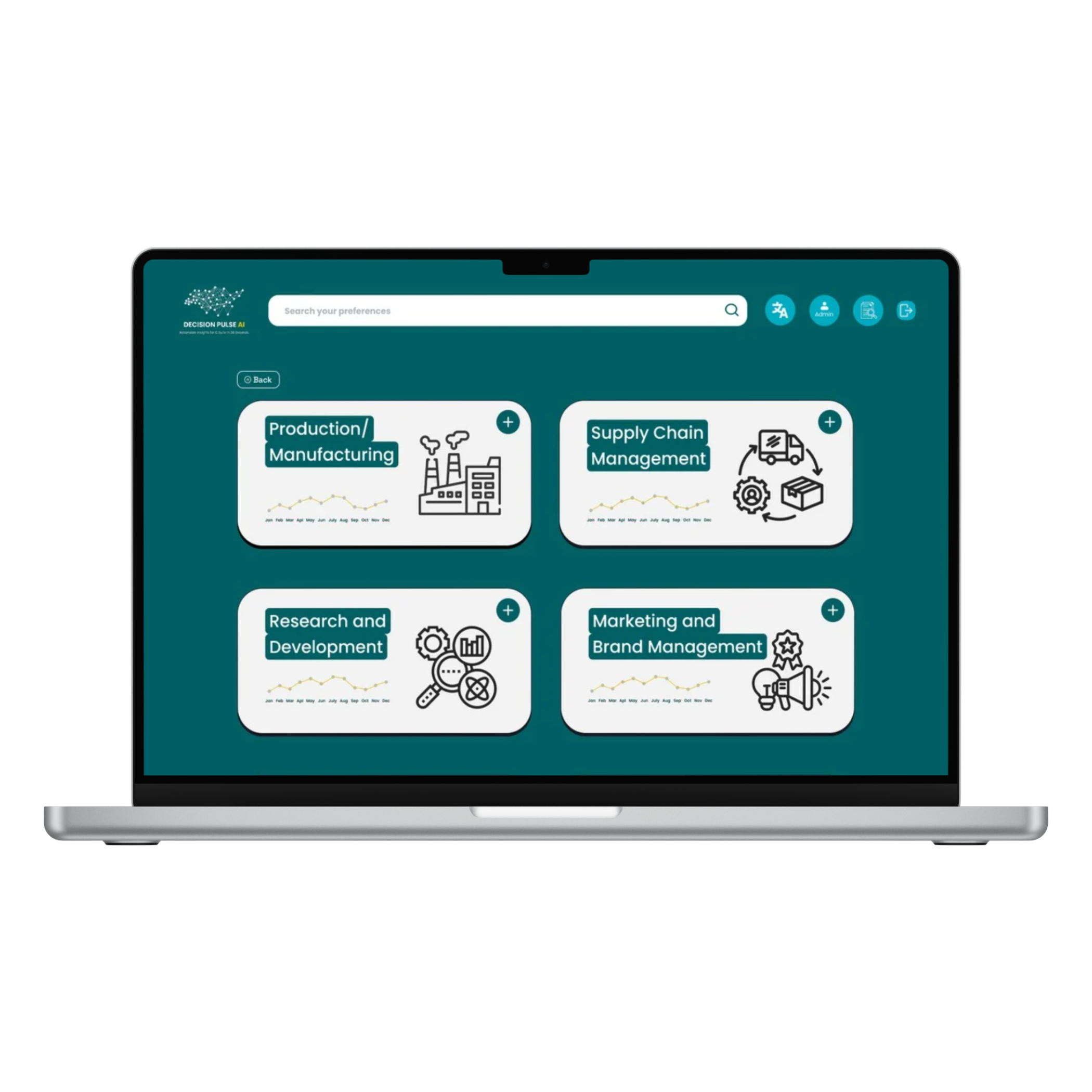
Decision Workflow
Why Traditional BI and AI Tools Fail
to Drive Decisions
Enterprise information can be distributed across reports, applications, warehouses, and spreadsheets. Teams may use different metric definitions, investigate changes manually, or lack a clear owner for the next step. Decision intelligence connects analysis with business context, approval, and outcome measurement. Learn more about this evolution here.
The Hindsight Trap: Descriptive reporting explains what happened. Diagnostic analysis investigates possible contributors, while predictive and prescriptive methods can help evaluate future scenarios.
The Black Box: Generated analysis should make its data, definitions, filters, assumptions, and uncertainty visible. Correlation alone does not establish cause.
Workflow Fragmentation: Analysis needs a responsible owner, approval rules, and an outcome measure. Any action through CRM, ERP, or another system depends on configured and authorized integrations.
The Context Vacuum: External or competitor data may add context when it is available, licensed, reliable, and appropriately connected. Its availability should not be assumed for every deployment.
External and Competitor Context
Consider approved external information alongside internal data, with source quality, rights, and freshness made clear.
Introducing Decision
Intelligence
Decision Pulse AI is positioned as a Generative BI and decision-intelligence platform. Its public materials describe natural-language data exploration, analytics, scenario evaluation, and recommendations. Actual workflows depend on connected data, configuration, permissions, and product entitlements. related analytics guidance can provide additional context. Forecasts and recommendations remain estimates for review, not mathematical certainty.
From Data to Decisions in 4 Stages
A decision workflow connects business context, evidence, evaluation, accountable action, and outcome review. Specific integrations and automation depend on the deployed configuration.
Understand the Business and Its Data
Start with a recurring business decision, its owner, the relevant source systems, approved metrics, data quality, access requirements, and current process. The available connections and preparation work depend on the selected deployment and source systems.
A Team of AI Agents Working for You
The original product positioning describes specialized Marketing, Pricing, Data, and Approval agent roles. Confirm current availability and functionality with the product team; use appropriate review and approval controls.
Agent descriptions are product positioning, not a substitute for verified customer outcomes or professional advice. Read about AI and consulting approaches.
Go Beyond
Internal Data
Decision Pulse AI is positioned to support analysis across connected business data. External market or competitor information may add context when the source, rights, quality, freshness, and integration are confirmed. The available data and workflows vary by deployment.


Test Decisions Before
You Make Them
Compare modeled outcomes under explicit assumptions. Scenario results are estimates, not mathematical certainty; confirm the specific simulation methods and limits for the current product offer.
State the baseline and assumptions being tested.
Compare alternatives and sensitivity to uncertain inputs.
Review constraints, risks, and trade-offs before a decision.
Explore Data
and Evaluate Scenarios
- •Natural-Language Exploration: The Marketplace listing describes asking questions across connected datasets.
- •Scenario Analysis: Compare possible outcomes with explicit inputs and assumptions.
- •Reporting and Insight Delivery: Public materials describe automated reports and scheduled insights; confirm current options.
- •Monitoring and Alerts: Confirm supported thresholds, channels, and alert configuration for your deployment.
Illustrative Scenario
Modeled Outcome
Example
Uncertainty
Review

Evaluating Decision Pulse AI
| Capability | Typical Traditional BI | Typical Generative BI Tools | Decision Pulse AIAs Positioned |
|---|---|---|---|
Descriptive and diagnostic analysis | |||
Predictive and prescriptive analysis | |||
Scenario evaluation | |||
Business context and rules | |||
Explainability and confidence | |||
Decision workflow |
Connect Business
Data to a
Decision Workflow.
Decision Pulse AI is positioned to help teams explore data, evaluate options, and support business decisions. The suitable data sources, workflows, and controls depend on the selected use case and verified product capabilities.
Potential Business Use Cases

Industry
FMCG

Financials
BFSI

Research
Pharma

Commerce
Retail
Industry
FMCG
Pricing and demand scenarios
Financials
BFSI
Financial planning analysis
Research
Pharma
Sales and territory analysis
Commerce
Retail
Inventory and promotion review
Stop Analyzing.
Start Deciding.
Use a representative business decision to evaluate the platform's data, analytics, scenarios, integrations, governance, and approval needs. Results and capabilities depend on the configured product and use case.


