How Office Solution AI Labs Can Help Your Startup Explore Azure and AWS Cloud Credits
 0|
 0
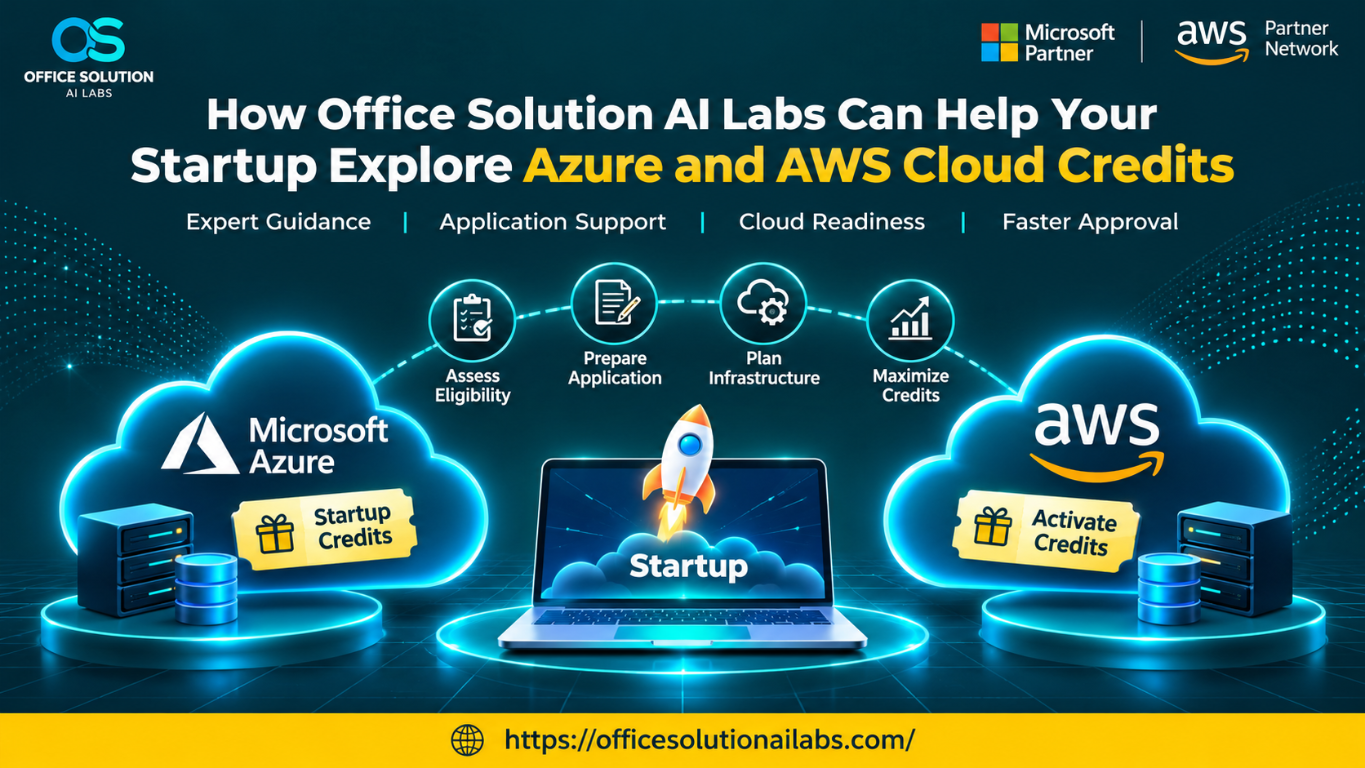
Table of Contents
Startups often need cloud infrastructure before revenue is predictable. Whether you are building a SaaS product, generative AI application, machine-learning workflow, or enterprise software, compute, databases, storage, networking, and monitoring can all create costs early in product development. Microsoft Azure and Amazon Web Services (AWS) have programs that may help eligible businesses offset some cloud usage, but understanding program fit and preparing a realistic plan takes work.
Office Solution AI Labs helps eligible startups explore public Azure and AWS credit opportunities, organize application information, assess cloud requirements, and plan for credit usage and ongoing costs. Depending on the company's profile and programs available when it applies, a startup may be able to explore opportunities described as up to USD $125,000 in cloud credits. This is not a guaranteed award, cash payment, or standard provider benefit. Microsoft and AWS independently determine eligibility, approvals, award amounts, service coverage, and terms.
For an overview of the programs themselves, see our Free Azure and AWS Credits guide. This article focuses on how to prepare, what application-readiness support can cover, and how to plan infrastructure responsibly.
Explore cloud credit options with a clear plan
Discuss your startup, product, and planned cloud workload with Office Solution AI Labs.
What Can Office Solution AI Labs Help With?
- Understand your company and product: Organize the business profile, product stage, ownership, business model, and customer use case.
- Review potential program fit: Compare your information with the published Microsoft and AWS program criteria, and flag items that need provider confirmation.
- Prepare application information: Make product, company, funding, and infrastructure descriptions clear, accurate, and consistent.
- Estimate cloud requirements: Inventory workloads and develop a usage estimate using provider pricing resources and stated assumptions.
- Plan credit utilization: Connect cloud services and expected usage to product milestones instead of spending credits just to use them.
- Prepare for ongoing costs: Review budgets, alerts, expiry dates, eligible charges, and the likely post-credit bill.
A Practical Cloud Credit Readiness Process
Understand your company and product
Start with a clear description of what the company is building, who it serves, how the product works, and its current stage.
- Identify the company name, location, website, founding date, and business model.
- Describe whether the product is at concept, prototype, MVP, beta, launched, or growth stage.
- Clarify whether the business owns the software product or delivers services for another company.
- Keep funding, investor, and accelerator information accurate and consistent.
Assess Azure and AWS program fit
Consider provider programs separately; eligibility and account history can differ.
- Review Microsoft for Startups and distinguish it from the Azure free-account offer.
- Review AWS Activate Founders or Portfolio as applicable, and distinguish them from AWS Free Tier.
- Check previous credits, account requirements, company eligibility, and any investor or provider referral requirements.
- Record uncertainties for confirmation from the provider's current official program materials.
Prepare a clear application profile
Explain the product in plain language and connect the requested cloud usage to real product needs.
- Describe the problem, users, product functionality, and development stage.
- Explain why the workload needs cloud resources and what those resources will support.
- Check company, product, funding, and partnership claims against reliable records.
- Do not exaggerate product maturity, user numbers, revenue, investment, or provider relationships.
Organize technical and financial requirements
Build a workload inventory and estimate usage based on configuration and realistic assumptions.
- List compute, databases, storage, networking, AI inference, data processing, observability, security, and backups.
- Estimate hours, capacity, data growth, requests, model usage, and operating regions where known.
- Separate baseline, testing, and growth scenarios rather than applying an arbitrary growth multiplier.
- Use provider calculators and pricing pages; estimates are not quotes and actual charges vary.
Plan how credits support product milestones
Choose an architecture that fits the workload and product stage, not one designed simply to consume a credit balance.
- Map planned services to prototype, beta, and launch milestones.
- Balance cost control with security, backups, reliability, and performance requirements.
- Set budgets and alerts and review spend, top cost drivers, and idle resources regularly.
- For AI workloads, monitor model choice, request volume, tokens, caching, embeddings, storage, and evaluation.
Manage expiry and the post-credit transition
Plan for standard billing before credits expire or are exhausted.
- Record the approved amount, activation date, expiry date, covered services, and account or subscription.
- Forecast the normal monthly bill and identify workloads that can be optimized or scaled down.
- Consider migration only after comparing engineering effort, data transfer, downtime, security, and operational risk.
- Keep cloud accounts, billing relationships, and identity administration under the company's control.
What Information Should You Prepare?
| Area | Useful information to organize | Why it matters |
|---|---|---|
| Company | Name, website, location, founding date, ownership, and business model | Helps explain the business profile and check provider criteria. |
| Product | Problem solved, target users, product functionality, and development stage | Gives reviewers a concrete and accurate product description. |
| Funding and affiliations | Funding stage, self-funded status, investor, accelerator, and referral details if applicable | Some program pathways depend on funding or a participating provider relationship. |
| Account history | Existing Azure or AWS accounts and previous promotional credits | Prior usage or credits may affect eligibility and account setup. |
| Technical workload | Compute, database, storage, networking, AI, data processing, security, and backups | Supports a credible usage plan and cost estimate. |
| Cost planning | Baseline, testing, growth assumptions, budgets, alerts, and post-credit estimate | Helps prevent unplanned spend when credits are exhausted or expire. |
Keep the application profile factual and internally consistent. A clear explanation of a working product and its infrastructure needs is more useful than broad claims or a list of cloud service names without context.
Azure and AWS Programs: Choose Based on Fit
| Consideration | Microsoft Azure | Amazon Web Services |
|---|---|---|
| Startup program | Microsoft for Startups | AWS Activate |
| Separate introductory offer | Azure free account for eligible new customers | AWS Free Tier for eligible new customers |
| Potential pathway differences | Standard and Investor Network routes may have different requirements and benefits | Founders and Portfolio routes have different eligibility and provider-affiliation requirements |
| Key checks | Product eligibility, account history, activation, milestones, and sponsorship terms | Account plan, prior credits, funding, provider relationship, Organization ID, and credit terms |
| Important reminder | Published maximums are not guaranteed awards | Published maximums are not guaranteed awards |
A credit amount alone is not a reason to choose a cloud platform. Consider product architecture, team skills, customer requirements, security, compliance, account history, operational complexity, and long-term cost. Running on both providers can add identity, monitoring, networking, deployment, and billing overhead; use a multi-cloud design only when there is a clear requirement or business case.
Who Can Benefit from Cloud Credit Readiness Support?
- AI and generative AI startups: Estimate inference, model evaluation, GPU or compute needs, data storage, embeddings, and expected usage.
- SaaS companies: Plan application hosting, databases, backups, monitoring, deployment pipelines, and separate development and production environments.
- Data and machine-learning teams: Account for data movement, experiment frequency, processing time, storage growth, and usage controls.
- Software product businesses: Explain the product the company owns and verify program fit; service businesses and agencies may be treated differently under some criteria.
What Office Solution AI Labs Does—and Does Not—Promise
Subject to an agreed scope, Office Solution AI Labs can help organize company and technical information, review published program criteria, identify questions for the provider, clarify product and workload descriptions, prepare an infrastructure estimate, and plan usage and post-credit costs. Deliverables, timeline, fees, and responsibilities should be confirmed in writing before work begins.
Microsoft and AWS control their own programs and make their own eligibility and award decisions. Office Solution AI Labs cannot guarantee an approval, a specific credit amount, an exception to program rules, or coverage for every charge. It does not issue provider credits. A provider partnership, endorsement, accelerator status, or Activate Provider relationship should not be inferred unless it is current and independently verifiable.
Common Mistakes to Avoid
- Treating an advertised maximum as the usual or guaranteed award.
- Confusing a free-tier offer with a startup-credit program.
- Applying without checking company, product, account, funding, and prior-credit eligibility.
- Using inconsistent company details or describing an idea as a launched product.
- Assuming a referral code, investor affiliation, or provider Organization ID without verifying it.
- Overestimating infrastructure or assuming every charge will be covered.
- Leaving resources running or failing to track balance and expiry.
- Sharing passwords, MFA codes, private keys, or recovery codes with an adviser.
- Building production around credits that have not been approved and activated.
- Ignoring the likely bill after promotional credits end.
Frequently Asked Questions
Frequently Asked Questions
Q.Can Office Solution AI Labs guarantee that my startup will receive cloud credits?
A.No. Microsoft or AWS makes the final eligibility and award decision for its programs. Office Solution AI Labs can help with readiness and planning but cannot guarantee approval or a specific amount.
Q.Can I explore up to USD $125,000 in cloud credits?
A.Office Solution AI Labs can help eligible businesses explore opportunities described as up to USD $125,000, subject to program availability, eligibility, provider approval, and applicable terms. This is not a guaranteed award, cash payment, or standard provider benefit.
Q.Does Office Solution AI Labs issue Azure or AWS credits directly?
A.No. Credits are governed and issued by the relevant provider program. Office Solution AI Labs may help a business understand options and prepare information within the agreed service scope.
Q.What is the difference between startup credits and a free-tier offer?
A.Startup programs such as Microsoft for Startups and AWS Activate have their own application routes and eligibility requirements. Azure free account and AWS Free Tier offers are separate introductory experiences with distinct usage limits and terms.
Q.Can a self-funded startup apply for AWS Activate?
A.AWS publishes a Founders route for qualifying self-funded startups. Check the current eligibility criteria and application requirements; self-funded status alone does not guarantee approval.
Q.What should I prepare before discussing cloud credit options?
A.Prepare your company website, product summary, business model, development stage, funding or accelerator information, account history, previous credits, and a basic cloud workload estimate. Do not send passwords, MFA codes, payment details, or access keys.
Q.Can cloud credits cover every service or charge?
A.No. Coverage depends on the specific award terms and account. Some services or charges may be excluded, so check the provider terms and billing console before relying on credits.
Q.What happens when promotional credits expire?
A.Continued usage may incur standard charges or be affected by the offer's terms. Track the expiry date, forecast paid costs early, and decide what to optimize, scale down, or continue.
Q.Should I choose Azure or AWS based on the largest advertised credit?
A.No. Compare architecture, team skills, customer requirements, security, compliance, eligibility, operational complexity, and long-term costs. A credit maximum is not a guaranteed award.
Take the Next Step
Tell us what your company is building, which cloud platform you use or plan to use, and what infrastructure challenge you are solving. Office Solution AI Labs can help you explore potential credit pathways and make a practical plan, while the provider remains responsible for all application and award decisions.
Ready to discuss your cloud credit plan?
Explore Azure and AWS program fit, application readiness, workload planning, and post-credit costs.
Official Program Resources
- Microsoft for Startups
- Microsoft for Startups Azure benefits
- Microsoft for Startups FAQs
- Azure free account and cost guidance
- AWS Activate
- AWS Activate application guide
- AWS credits and promotional terms
- AWS Free Tier
Program rules and benefits can change. Confirm the latest information on official Microsoft and AWS pages before applying. Do not share passwords, MFA codes, payment-card information, or other sensitive credentials when seeking guidance.


